
The frustrating truth about Achilles tendonitis — and why most people never fully heal it.

You felt it a few weeks ago. That familiar tightness at the back of your heel when you rolled out of bed in the morning. Maybe a dull ache after your Saturday pickleball game, a little stiffness after your morning run, or soreness during that last set of box jumps.
You did what most people do. You rested. You iced it. You stretched your calf every night. And after a week or two? It felt better.
So you got back out there.
And then it came back — sometimes worse than before.
If that story sounds familiar, you’re not alone. Achilles tendonitis is one of the most common overuse injuries in adults over 40 who are still active, still competing, and still pushing themselves. And the frustrating part? Most people manage the symptoms without ever addressing the actual problem.
That cycle ends today. Let’s talk about what’s really going on with your Achilles — and what it actually takes to fix it for good.
What Is Achilles Tendonitis, Really?
Your Achilles tendon is the thick cord of tissue that connects your calf muscles to your heel bone. It handles an enormous amount of load every single day — absorbing force when you walk, run, jump, cut, and push off.
Achilles tendonitis (sometimes called Achilles tendinopathy) happens when that tendon gets overloaded beyond its capacity to recover. This is especially common in active adults over 40 for a few key reasons:
- Tendon tissue changes as we age. After 40, tendons become less elastic and take longer to recover from stress. The tendon that could bounce back in 24 hours at 25 might need 48–72 hours at 45.
- Activity load spikes. Weekend warriors — runners, golfers, CrossFitters, pickleball players — often do very little during the week and then go hard on the weekends. That inconsistency is a recipe for tendon overload.
- The “push through it” mentality. Active adults tend to minimize pain. A little heel soreness doesn’t feel like a big deal — until it becomes a very big deal.
The result is a tendon that’s repeatedly stressed, never fully recovered, and slowly breaking down over time.
The “Rest → Better → Pain Returns” Trap
Here’s the pattern that plays out constantly with Achilles tendonitis:
Pain flares up → You rest → The pain fades → You return to activity → Pain comes back.
Sound familiar?
Here’s why it keeps happening: rest reduces inflammation and irritation, but it does absolutely nothing to rebuild the tendon’s capacity to handle load. The tendon is still weak, still disorganized at the tissue level, still unable to tolerate the demands you’re placing on it.
When you return to activity without actually rehabilitating the tendon, you’re going right back to the same scenario that caused the problem in the first place. Rest is not recovery. It’s just a temporary pause.
This is the difference between symptom relief and actual healing — and it’s the most important concept to understand if you want to break this cycle.
What Tendon Healing Actually Requires
Tendons are notoriously slow healers. Unlike muscles, which have a rich blood supply, tendons receive relatively poor circulation. This means the healing process is gradual — and it requires the right kind of input to happen properly.
Here’s what tendon healing actually needs:
Progressive mechanical loading. Tendons heal and remodel in response to controlled stress. This might sound counterintuitive — you’re injured, so why would you load it? But research consistently shows that appropriately dosed, progressive loading is what drives tendon tissue to reorganize, strengthen, and become more resilient. Without it, the tendon heals in a disorganized way and remains vulnerable.
Consistency over time. Tendon healing isn’t a two-week process. Depending on severity, real structural improvement takes 8–12 weeks minimum. This doesn’t mean 8–12 weeks of pain — most people feel significantly better much sooner. But feeling better and being fully healed are two very different things.
Reduced irritating load, not zero load. Complete rest can actually cause the tendon to become more sensitive and deconditioned. The goal is to find the right balance: enough activity to drive healing, not so much that you’re constantly re-aggravating it.
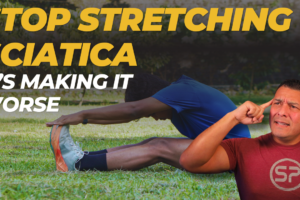
Why Stretching Isn’t Enough (and Might Actually Make It Worse)
Let’s talk about the most common thing people do for Achilles tendonitis: stretching.
You’ve probably been standing on a step and dropping your heel down, or pressing your foot against a wall to stretch your calf. It feels good. It might even give you temporary relief.
But here’s the truth: passive stretching alone doesn’t fix Achilles tendonitis.
In fact, aggressive stretching — especially when the tendon is already irritated — can actually compress and further stress the tendon tissue. Stretching addresses muscle flexibility, but it does very little to build the strength and load-bearing capacity that a damaged tendon needs to recover.
Flexibility is not the problem. Weakness and load intolerance are the problem.
Why Strength Is the Real Solution
This is the part most people miss entirely.
The Achilles tendon acts as a force transmitter between your calf muscles and your foot. If the calf-Achilles complex is weak or poorly conditioned, the tendon absorbs more stress than it should with every step, push-off, and landing.
Strengthening the calf-Achilles unit — specifically through eccentric and heavy slow resistance training — is the most evidence-informed approach to rehabilitating Achilles tendonitis. This type of training challenges the tendon under load in a controlled way, driving the structural remodeling it needs to heal properly.
For active adults over 40, this is especially critical. Age-related declines in tendon stiffness and calf strength mean that maintaining a well-conditioned lower leg is essential not just for recovery, but for prevention.
And it’s not just about your calf. Hip strength, ankle mobility, single-leg stability, and overall movement mechanics all play a role in how much stress lands on your Achilles during your pickleball match, your long run, or your CrossFit workout. A comprehensive approach looks at the whole system — not just the painful spot.
You Don’t Have to Keep Living in This Cycle
If you’ve been battling Achilles pain for weeks, months, or even longer, here’s what we want you to know: this is fixable. But it requires the right approach — one that goes beyond rest and stretching and actually builds your tendon back up to meet the demands of the activities you love.
You’re not too old to run, compete, or train hard. You just need a plan that respects the biology of tendon healing and gives your body the progressive challenge it needs to come back stronger.
Ready to Break the Cycle?
We created our Achilles Tendonitis Relief Class specifically for active adults who are tired of the rest-recover-reinjure loop. This class walks you through the exact loading strategies, movement corrections, and rehab progressions that actually drive tendon healing — so you can get back to what you love and stay there.
👉 Register for our Achilles Tendonitis Relief Class here
Spots are limited. Your Achilles has been patient long enough. Let’s actually fix it.
The Bottom Line
Achilles tendonitis isn’t just about pain. It’s about a tendon that has been repeatedly overloaded without being properly strengthened and recovered. Rest buys you time — but it doesn’t build resilience. Stretching feels good — but it doesn’t rebuild capacity.
What your Achilles needs is progressive, intelligent loading that rebuilds the tendon from the inside out. Combined with the right guidance, most active adults can not only recover from Achilles tendonitis — they can come back with a stronger, more durable lower leg than they had before.
Pain-free is the starting point. Getting back on the court, the trail, or the platform — that’s the goal.
👉 Register for our Achilles Tendonitis Relief Class and let’s get you there.
As always, we hope this helps! For any questions and all suggestions, please email us at TeamSP@SportsPerformancePT.com
If you want to know more information about how we can help, get started with a FREE discovery phone call.
Click the following link -> DISCOVERY PHONE CALL.
If you’re interested in doing Physical Therapy at Sports Performance -> CLICK HERE TO LEARN MORE & INQUIRE
If you would like to see more from us at Sports Performance… Watch our Podcast episode 141 about How to Improve your Long Term Health and Wellness -> CLICK HERE
– Dr. Chris

STAY CONNECTED
Instagram: CLICK HERE
Facebook: CLICK HERE
YouTube: CLICK HERE
Podcast: CLICK HERE
TUNE IN TO OUR PODCAST