

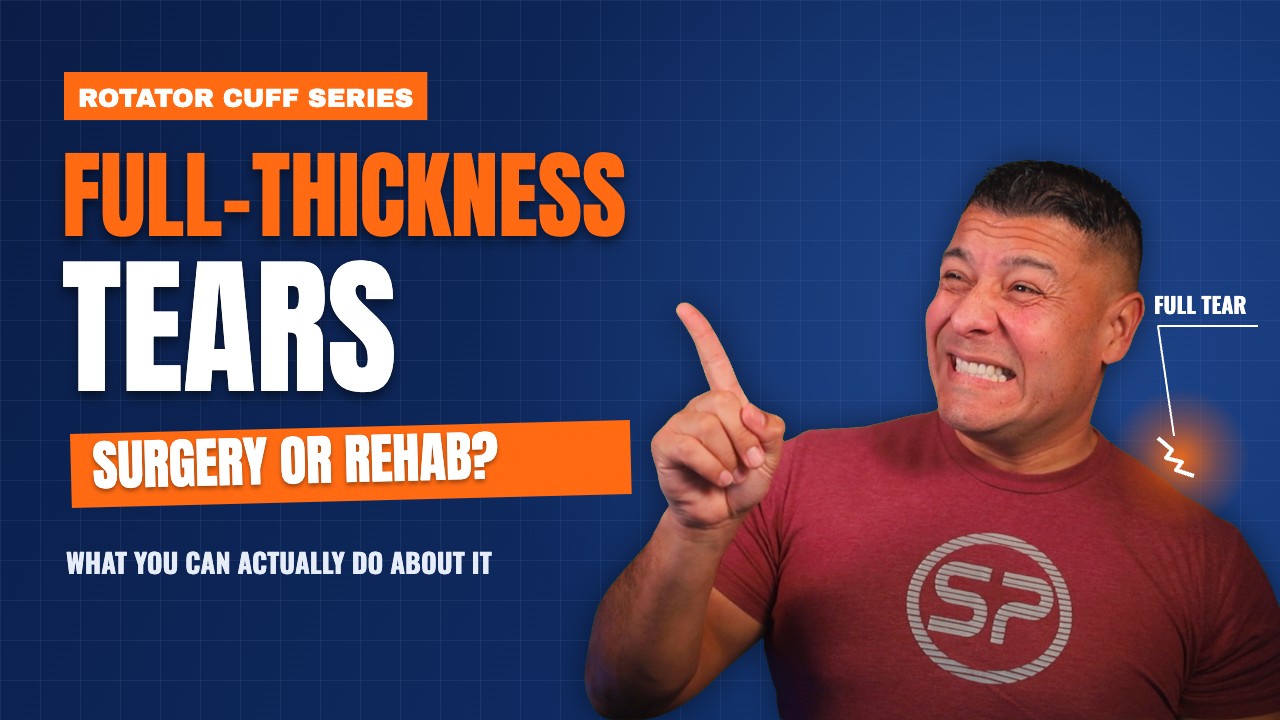
If you’ve been told you have a “full-thickness rotator cuff tear,” your mind probably jumped straight to surgery. It’s a scary-sounding diagnosis — but here’s the truth: not every full-thickness tear needs an operation, and even when surgery is the right call, your recovery depends heavily on what happens in rehab, not just what happens on the operating table.
Let’s break down what’s actually going on in your shoulder, what your options are, and how to make a confident, informed decision about your care.
What Does “Full-Thickness Tear” Actually Mean?
Your rotator cuff is a group of four muscles and tendons that wrap around your shoulder joint, keeping the ball of your humerus centered in its socket while allowing you to lift, rotate, and reach overhead. A full-thickness tear means one of these tendons — most commonly the supraspinatus — is torn all the way through, from the top surface to the bottom surface. This is different from a partial tear, where some fibers remain intact.
Full-thickness tears come in a range of sizes:
- Small to medium tears — less than 3 cm
- Large tears — 3 to 5 cm
- Massive tears — greater than 5 cm, sometimes involving more than one tendon
Size matters, but it’s not the only factor that determines your treatment path.
Traumatic vs. Degenerative Tears
This distinction matters more than most people realize:
- Traumatic tears happen suddenly — a fall onto an outstretched arm, a heavy lifting injury, or a forceful pulling motion. These often occur in otherwise healthy tendons and tend to cause a sudden, sharp pain followed by significant weakness.
- Degenerative tears develop gradually over years as tendon tissue naturally wears down with age, repetitive overhead use, or reduced blood supply to the area. Many people with degenerative tears don’t even remember a specific injury — the tear was simply discovered after symptoms built up slowly.
This is a key point: a large number of full-thickness tears in adults over 40 are degenerative, and research consistently shows many of these tears can be managed without surgery.
Common Symptoms
Regardless of the cause, full-thickness tears often produce a familiar pattern:
- Weakness when lifting the arm, especially overhead or out to the side
- Difficulty reaching behind your back or overhead (putting on a jacket, reaching a shelf)
- Night pain, especially when lying on the affected shoulder
- A feeling of instability or “give-way” weakness
- Loss of function in daily tasks — carrying groceries, lifting a child, swinging a golf club
Some people also describe a catching or grinding sensation with movement.
Why Many Degenerative Tears Can Be Treated Without Surgery
Here’s something that surprises a lot of patients: a torn tendon doesn’t always equal a dysfunctional shoulder. The body is remarkably good at compensating. Surrounding muscles — particularly the deltoid and the rest of the rotator cuff — can often be trained to pick up the slack and restore strength, stability, and pain-free movement.
Physical therapy for a degenerative full-thickness tear typically focuses on:
- Reducing pain and inflammation
- Restoring range of motion
- Progressive strengthening of the rotator cuff and scapular stabilizers
- Improving shoulder mechanics to reduce stress on the torn tendon
- Gradual return to lifting, sport, or overhead activity
Many patients see meaningful improvement in pain and function through this approach — without ever needing surgery. That said, conservative care isn’t a guarantee for everyone, which is why proper evaluation matters.
When Surgery Becomes the Better Option
Surgical repair tends to be favored in certain situations:
- Acute, traumatic tears — especially in someone who was functioning well beforehand and suddenly lost strength
- Younger, highly active patients who want to return to demanding sport or occupational lifting
- Large or massive tears, which have a higher likelihood of progressing or affecting long-term function
- Progressive weakness despite a good effort with conservative treatment
- Failed conservative care — persistent pain or dysfunction after several months of appropriate rehab
If you fall into one of these categories, your physical therapist and physician will likely discuss surgical consultation as part of a well-rounded plan.

📅 Not Sure Which Category You Fall Into?
That’s exactly what a proper evaluation is for. Book a Shoulder Evaluation — we’ll assess your tear, your strength, and your goals to help you understand your realistic options before you commit to any path.
What Rehab Looks Like — Before and After Surgery
Pre-Surgical (Prehab) Phase
If surgery is being considered, “prehab” — strengthening the shoulder and surrounding muscles beforehand — can improve post-surgical outcomes and help you understand your baseline strength and mobility.
Post-Surgical Recovery Phases
Phase 1: Protection (Weeks 0–6) — Your arm is typically in a sling, and movement is passive or assisted to protect the healing repair while preventing stiffness.
Phase 2: Range of Motion (Weeks 6–12) — As healing progresses, therapy shifts toward restoring full passive and active motion without stressing the repair.
Phase 3: Progressive Strengthening (Months 3–6) — This is where the real rebuilding happens — targeted strengthening of the rotator cuff, scapular muscles, and surrounding shoulder complex.
Phase 4: Return to Activity (Months 5–9+) — Sport-specific or job-specific training, return to lifting, throwing, or overhead work, with ongoing monitoring for strength and symmetry.
Realistic Timelines
Whether treated conservatively or surgically, shoulder recovery is a marathon, not a sprint. Non-surgical rehab often shows meaningful progress within 6–12 weeks, while surgical recovery typically takes 6 months to a full year to reach complete strength and return to high-demand activity. Patience and consistency in rehab are the biggest predictors of long-term success — more so than the repair itself.
Why Early Evaluation Matters
The earlier a rotator cuff tear is properly evaluated, the more options you have. Waiting too long can allow weakness to progress, muscles to atrophy, or a small tear to become a larger one — narrowing your path to recovery. An experienced evaluation can determine your tear pattern, your strength deficits, and whether conservative care is a realistic first step for you.
Let’s Build Your Plan
A full-thickness tear doesn’t have to mean an automatic trip to the operating room — but it also shouldn’t be ignored. The right next step depends on your specific tear, your goals, and your activity level.
Book a Shoulder Evaluation today, and let’s figure out the smartest path back to pain-free, confident movement — whether that’s through rehab, surgery, or a combination of both.
This blog is for educational purposes only and does not replace individualized medical advice. Please consult with a physical therapist or physician regarding your specific condition before beginning any treatment program.
As always, we hope this helps! For any questions and all suggestions, please email us at TeamSP@SportsPerformancePT.com
If you want to know more information about how we can help, get started with a FREE discovery phone call.
Click the following link -> DISCOVERY PHONE CALL.
If you’re interested in doing Physical Therapy at Sports Performance -> CLICK HERE TO LEARN MORE & INQUIRE
If you would like to see more from us at Sports Performance… Watch our Podcast episode 141 about How to Improve your Long Term Health and Wellness -> CLICK HERE
– Dr. Chris

STAY CONNECTED
Instagram: CLICK HERE
Facebook: CLICK HERE
YouTube: CLICK HERE
Podcast: CLICK HERE
TUNE IN TO OUR PODCAST




Leave a reply