

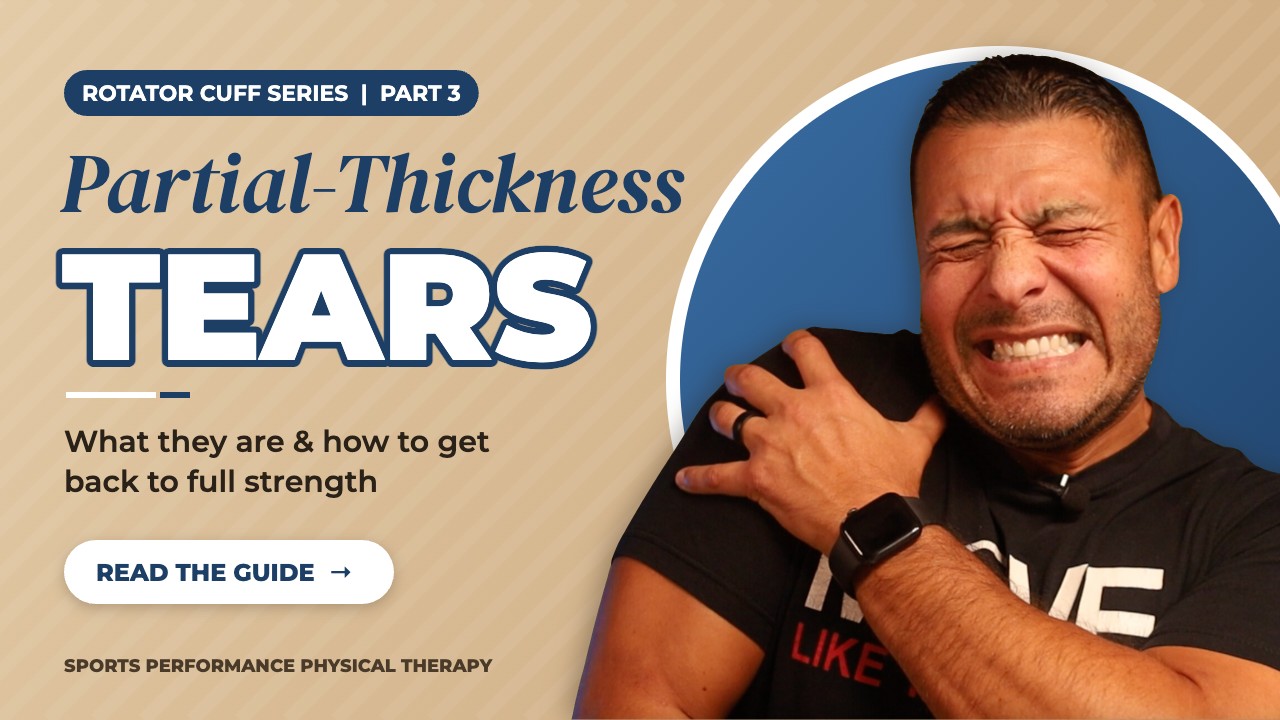
If you’ve been told you have a “partial tear” in your rotator cuff, you’ve probably had two reactions: relief that it’s not a full tear, and confusion about what that actually means for your shoulder, your training, and your timeline back to normal activity.
You’re not alone. Partial-thickness rotator cuff tears are one of the most common shoulder injuries we see in active adults — from weekend warriors throwing batting practice to lifters chasing a new overhead press PR to the 45-year-old who “just reached for something in the garage” and felt a pinch that never quite went away.
The good news? Most partial-thickness tears respond very well to the right treatment, and surgery is often not the first — or only — answer.
What Exactly Is a Partial-Thickness Rotator Cuff Tear?
Your rotator cuff is a group of four muscles and tendons that wrap around your shoulder joint, keeping the ball of your humerus centered in its socket while allowing you to lift, rotate, and press. Think of it as the stabilizing engine behind nearly every upper-body movement you make.
A partial-thickness tear means the tendon fibers are damaged, but the tendon hasn’t torn all the way through. This is different from a full-thickness tear, where the tendon is completely severed from one side to the other.
Partial tears are further classified by where the damage occurs:
- Articular-side tears — on the joint side of the tendon (the side facing the ball of the shoulder). These are more common and often related to repetitive overhead motion or age-related wear.
- Bursal-side tears — on the outer side of the tendon (facing the bursa, a cushioning sac). These are more frequently associated with impingement, where the tendon rubs against the bony arch above it.
Both types can range from mild fraying to tears involving a significant percentage of the tendon’s thickness. Your physical therapist and physician use this information, along with your symptoms and goals, to guide your treatment plan.
Who Gets These Tears — and Why
Partial-thickness tears tend to show up in two overlapping groups:
- Overhead athletes — swimmers, throwers, volleyball players, and lifters who repeatedly load the shoulder in overhead positions, creating cumulative stress on the tendon.
- Active adults over 35–40 — as tendons naturally lose some elasticity and blood supply with age, they become more susceptible to wear-and-tear damage, especially with repetitive lifting, reaching, or a history of shoulder impingement.
A single traumatic event (a fall, a hard catch, a heavy lift with poor mechanics) can also cause a partial tear, but many develop gradually — which is why people are often surprised by the diagnosis. The pain didn’t start overnight, but the tendon damage may have been building for months.
Common Symptoms
- A deep, aching pain in the shoulder, often worse at night or when lying on that side
- Pain with overhead reaching, lifting, or pressing movements
- A feeling of weakness or “catching” during certain motions
- Discomfort reaching behind your back
- Pain that lingers after workouts involving pressing, throwing, or pulling
How Partial-Thickness Tears Are Diagnosed
Diagnosis typically starts with a thorough clinical exam — your physical therapist or physician will assess your range of motion, strength, and use specific orthopedic tests designed to stress the rotator cuff tendons and identify patterns consistent with a partial tear.
Imaging is often used to confirm the diagnosis and determine the extent of damage:
- Ultrasound is a quick, cost-effective way to visualize tendon structure and can be done dynamically (while you move your arm).
- MRI provides more detailed imaging and is especially useful for determining tear depth, location, and ruling out other shoulder pathology.
Importantly, imaging findings are interpreted alongside your symptoms and function — plenty of people have tendon changes on imaging with little to no pain, which is why a full clinical picture matters more than a scan alone.
Why Many Partial Tears Respond Well to Conservative Care
Here’s the encouraging part: research and clinical experience consistently show that many partial-thickness tears — especially those involving less than 50% of the tendon — improve significantly with physical therapy alone, without needing surgical intervention.
Why? Because much of the pain and dysfunction associated with these tears comes from surrounding issues that are very treatable: poor scapular (shoulder blade) control, weakness in the rotator cuff and surrounding musculature, altered movement patterns, and compensations that developed around the injury.
📅 Don’t Wait for It to “Figure Itself Out”
If shoulder pain has been holding you back from training, lifting, or simply reaching overhead without wincing, don’t wait for it to “figure itself out.” Book a Shoulder Evaluation with our team and let’s build a clear plan together.
What a Physical Therapy Program Looks Like
A well-structured rehab program for a partial-thickness rotator cuff tear typically progresses through several phases:
1. Pain Management & Calming the Tissue — Early focus is on reducing irritation through activity modification, gentle range-of-motion work, and manual therapy techniques to improve mobility without aggravating the tendon.
2. Scapular Control & Stability — Many shoulder issues are made worse by poor shoulder blade mechanics. We retrain the muscles that stabilize the scapula so your rotator cuff isn’t working overtime to compensate.
3. Progressive Rotator Cuff Strengthening — Once pain is managed, we introduce targeted strengthening — starting with isometrics and light resistance, then progressing to more dynamic, functional loading as tolerated.
4. Return to Sport, Lifting, or Daily Demands — The final phase rebuilds capacity for your specific goals — whether that’s an overhead press, a tennis serve, a swim stroke, or simply lifting groceries without a second thought. This is where “pain-free” becomes “strong and confident.”

When Is Surgery Considered?
Surgery isn’t the default for partial-thickness tears, but it may be recommended when:
- The tear involves a large percentage of tendon thickness
- Symptoms persist despite a consistent, well-run physical therapy program (typically 3–6 months)
- There’s significant weakness or functional loss affecting daily life or sport
- The tear is combined with other structural issues requiring surgical correction
If surgery is needed, physical therapy remains essential — both before (to optimize strength and mobility) and after (to guide a safe, structured return to full function).
Realistic Recovery Timelines
Every shoulder is different, but general guidelines include:
- Mild tears with early intervention: Noticeable improvement within 6–8 weeks, continued progress over 3 months
- Moderate tears: Often 3–6 months of progressive rehab to return to full activity, including sport or heavy lifting
- Post-surgical recovery: Typically 4–6 months or longer, depending on repair type and individual healing
Consistency matters more than speed. Rushing back too early is one of the most common reasons symptoms return.
Ready to Get Moving Without Shoulder Pain?
A partial-thickness rotator cuff tear doesn’t have to mean the end of your training, your sport, or your favorite activities. With the right evaluation and a progressive, individualized plan, most people get back to doing what they love — often stronger and more resilient than before.
Book a Shoulder Evaluation today, and let’s build your personalized path from pain-free to performing at your best.
This blog post is for educational purposes only and does not constitute medical advice. Every injury is unique — please consult a licensed physical therapist or physician for an individualized evaluation and treatment plan.
As always, we hope this helps! For any questions and all suggestions, please email us at TeamSP@SportsPerformancePT.com
If you want to know more information about how we can help, get started with a FREE discovery phone call.
Click the following link -> DISCOVERY PHONE CALL.
If you’re interested in doing Physical Therapy at Sports Performance -> CLICK HERE TO LEARN MORE & INQUIRE
If you would like to see more from us at Sports Performance… Watch our Podcast episode 141 about How to Improve your Long Term Health and Wellness -> CLICK HERE
– Dr. Chris

STAY CONNECTED
Instagram: CLICK HERE
Facebook: CLICK HERE
YouTube: CLICK HERE
Podcast: CLICK HERE
TUNE IN TO OUR PODCAST




Leave a reply