

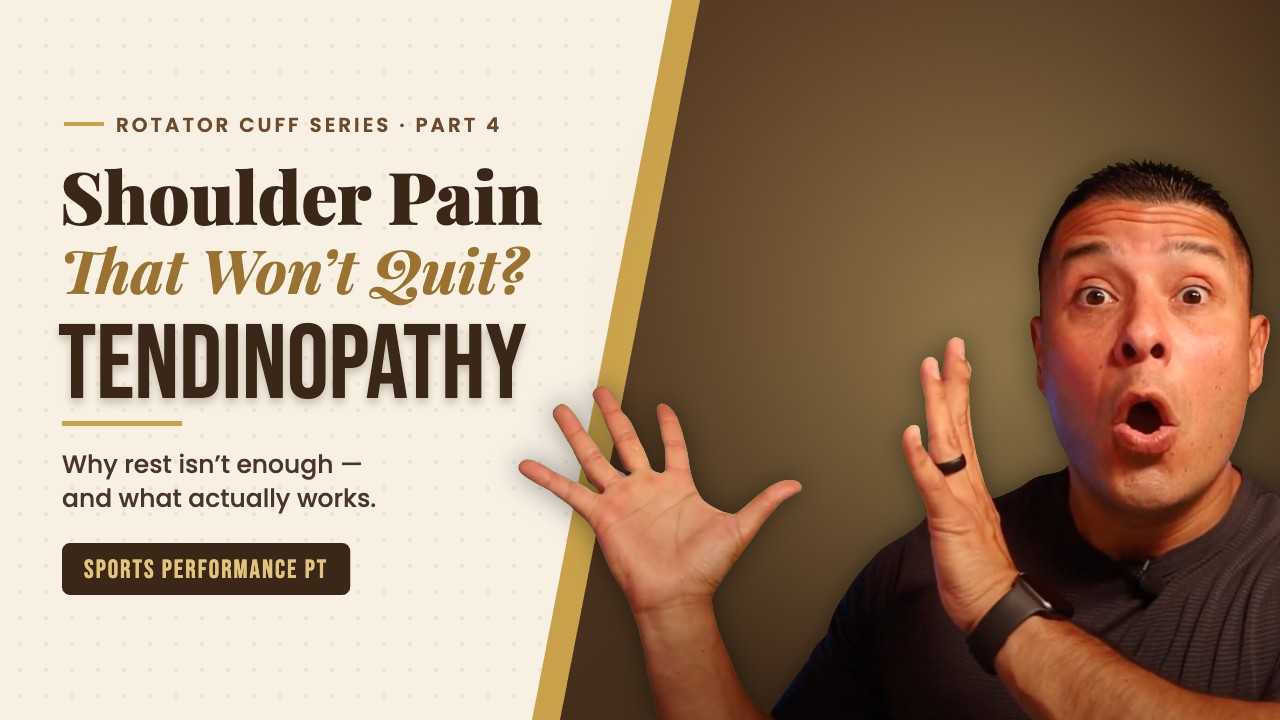
If you’ve been dealing with a nagging ache deep in your shoulder — the kind that flares up when you reach overhead, sleep on that side, or push through the last few reps of a workout — you’re not alone. And no, it’s probably not “just getting older.”
What you’re likely experiencing is rotator cuff tendinopathy, one of the most common shoulder issues we see in active adults, weekend warriors, and overhead athletes alike. The good news? It’s highly treatable, and understanding what’s actually happening in your shoulder is the first step toward fixing it — not just masking it.
Let’s break it down.
Tendinopathy vs. Tear: What’s the Difference?
These terms get used interchangeably, but they’re not the same thing — and the distinction matters for how we treat it.
Tendinopathy refers to a tendon that has become irritated, overloaded, or structurally changed over time. Think of it less as an “injury” in the traditional sense and more as a tendon that’s fallen behind on its ability to handle the demands you’re placing on it. The tissue is still intact, but it’s angry, inflamed in the early stages, and often weaker than it should be.
A tear, on the other hand, involves an actual disruption in the tendon fibers — partial or full thickness. Tears can happen suddenly (a fall, a hard pull) or develop gradually from long-standing, untreated tendinopathy.
Here’s the key takeaway: tendinopathy is often a process, not a single event. It builds over weeks or months, which is also why it tends to sneak up on people who “haven’t done anything” to explain the pain.
What Causes Rotator Cuff Tendinopathy?
This condition rarely has one single cause — it’s usually a combination of factors stacking up over time.
1. Overuse and repetitive overhead activity — Swimmers, throwers, lifters, painters, and anyone who spends a lot of time with arms overhead place repeated stress on the rotator cuff tendons. Over time, repetitive motion without adequate recovery can outpace the tendon’s ability to adapt.
2. Sudden load spikes — This is a big one for weekend warriors. Jumping from zero to five CrossFit classes a week, suddenly increasing your bench press, or picking up a new sport intensely after months of inactivity puts rapid demand on tissue that hasn’t been conditioned for it.
3. Poor posture and scapular control — Your shoulder blade (scapula) is supposed to move in coordination with your arm. When scapular control is poor — often from prolonged desk work, weak upper back muscles, or rounded-shoulder posture — the rotator cuff tendons get pinched and overworked with every overhead motion.
4. Age-related tendon changes — As we move past our 30s and 40s, tendons naturally lose some elasticity and blood supply. This doesn’t mean decline is inevitable — but it does mean the margin for error with training load and recovery gets a little smaller.
In most cases, it’s not one of these factors alone — it’s overuse plus a strength or mobility gap plus a training spike that tips things over the edge.

Common Symptoms to Watch For
Rotator cuff tendinopathy tends to show up in a few recognizable patterns:
- Pain when lifting the arm, especially overhead or out to the side
- A “painful arc” — discomfort in a specific range of motion (often between 60–120 degrees of arm elevation) that eases above or below that range
- Night pain, particularly when lying on the affected shoulder
- Weakness or fatigue with pressing, reaching, or carrying
- Stiffness that improves with movement but returns after activity
If this sounds familiar, you’re dealing with a very common — and very manageable — issue.
Why “Just Resting It” Often Doesn’t Work
We get it: when something hurts, the instinct is to stop using it. But complete rest is rarely the long-term answer for rotator cuff tendinopathy, and here’s why.
Tendons adapt to load. When you remove load entirely, the tendon doesn’t “heal” so much as it deconditions further. Then, when you return to activity — even normal daily activity — the tendon is in worse shape to handle it than before you stopped. This is often why shoulder pain seems to come back again and again despite weeks of “taking it easy.”
The tendon doesn’t need less stress forever. It needs the right amount of stress, applied progressively.
How Progressive Loading and Physical Therapy Help
This is where physical therapy makes the difference between temporary relief and lasting results.
A well-designed rehab plan addresses tendinopathy from multiple angles:
- Progressive loading exercises that gradually rebuild the tendon’s capacity to handle stress, without overwhelming it
- Scapular control and postural training to restore proper shoulder mechanics and reduce impingement during overhead motion
- Mobility work to address stiffness that may be contributing to compensatory movement patterns
- Activity modification — not elimination — so you can keep training, lifting, or playing your sport while your shoulder heals
- Education on load management so this doesn’t become a recurring issue every few months
The goal isn’t just to get you pain-free. It’s to rebuild a shoulder that can handle the demands of your sport, your lifting routine, or your daily life — without the fear of it flaring up again.
📅 Not Sure If Your Shoulder Pain Needs Professional Attention?
A quick evaluation can give you clarity and a clear path forward. 👉 Book a Shoulder Evaluation
When Should You Get Evaluated?
Shoulder pain is worth getting checked out if:
- It’s lasted more than 1–2 weeks without improvement
- It’s disrupting your sleep
- It’s limiting your training, lifting, or daily activities
- You’ve noticed new weakness along with the pain
- You’ve had shoulder issues before that keep coming back
Early evaluation matters. Rotator cuff tendinopathy caught and addressed early typically responds well to conservative treatment — and avoiding escalation to a more serious tear is always the better outcome.
The Bottom Line
Shoulder pain doesn’t mean you’re broken — it means your tendon is sending a signal that it needs support. With the right evaluation, a smart progressive loading plan, and attention to the movement patterns that got you here, most people return not just to pain-free, but to stronger and more durable than before.
You don’t have to figure this out on your own, and you don’t have to keep pushing through pain hoping it resolves itself.
👉 Book a Shoulder Evaluation and let’s build a plan to get you back to doing what you love — stronger than before.
This blog is for educational purposes only and is not a substitute for professional medical advice, diagnosis, or treatment. Please consult a licensed physical therapist or physician regarding your specific condition.
As always, we hope this helps! For any questions and all suggestions, please email us at TeamSP@SportsPerformancePT.com
If you want to know more information about how we can help, get started with a FREE discovery phone call.
Click the following link -> DISCOVERY PHONE CALL.
If you’re interested in doing Physical Therapy at Sports Performance -> CLICK HERE TO LEARN MORE & INQUIRE
If you would like to see more from us at Sports Performance… Watch our Podcast episode 141 about How to Improve your Long Term Health and Wellness -> CLICK HERE
– Dr. Chris

STAY CONNECTED
Instagram: CLICK HERE
Facebook: CLICK HERE
YouTube: CLICK HERE
Podcast: CLICK HERE
TUNE IN TO OUR PODCAST





Leave a reply